Halloween is a holiday celebrated on the night of October 31. Traditional activities include trick-or-treating, bonfires, costume parties, visiting "haunted houses" and carving jack-o-lanterns. Irish and Scottish immigrants carried versions of the tradition to North America in the nineteenth century. Other western countries embraced the holiday in the late twentieth century including Ireland, the United States, Canada, Puerto Rico and the United Kingdom as well as of Australia and New Zealand.
Halloween has its origins in the ancient Celtic festival known as Samhain (pronounced "sah-win").
The festival of Samhain is a celebration of the end of the harvest season in Gaelic culture. Samhain was a time used by the ancient pagans to take stock of supplies and prepare for winter. The ancient Gaels believed that on October 31, the boundaries between the worlds of the living and the dead overlapped and the deceased would come back to life and cause havoc such as sickness or damaged crops.
The festival would frequently involve bonfires. It is believed that the fires attracted insects to the area which attracted bats to the area. These are additional attributes of the history of Halloween.
Masks and consumes were worn in an attempt to mimic the evil spirits or appease them.
Trick-or-treating, is an activity for children on or around Halloween in which they proceed from house to house in costumes, asking for treats such as confectionery with the question, "Trick or treat?" The "trick" part of "trick or treat" is a threat to play a trick on the homeowner or his property if no treat is given. Trick-or-treating is one of the main traditions of Halloween. It has become socially expected that if one lives in a neighborhood with children one should purchase treats in preparation for trick-or-treaters.
The history of Halloween has evolved.The activity is popular in the United States, the United Kingdom, Ireland, Canada, and due to increased American cultural influence in recent years, imported through exposure to US television and other media, trick-or-treating has started to occur among children in many parts of Europe, and in the Saudi Aramco camps of Dhahran, Akaria compounds and Ras Tanura in Saudi Arabia. The most significant growth — and resistance is in the United Kingdom, where the police have threatened to prosecute parents who allow their children to carry out the "trick" element. In continental Europe, where the commerce-driven importation of Halloween is seen with more skepticism, numerous destructive or illegal "tricks" and police warnings have further raised suspicion about this game and Halloween in general.
In Ohio, Iowa, and Massachusetts, the night designated for Trick-or-treating is often referred to as Beggars Night.
Part of the history of Halloween is Halloween costumes. The practice of dressing up in costumes and begging door to door for treats on holidays goes back to the Middle Ages, and includes Christmas wassailing. Trick-or-treating resembles the late medieval practice of "souling," when poor folk would go door to door on Hallowmas (November 1), receiving food in return for prayers for the dead on All Souls Day (November 2). It originated in Ireland and Britain, although similar practices for the souls of the dead were found as far south as Italy. Shakespeare mentions the practice in his comedy The Two Gentlemen of Verona (1593), when Speed accuses his master of "puling [whimpering, whining], like a beggar at Hallowmas."
Yet there is no evidence that souling was ever practiced in America, and trick-or-treating may have developed in America independent of any Irish or British antecedent. There is little primary Halloween history documentation of masking or costuming on Halloween — in Ireland, the UK, or America — before 1900. The earliest known reference to ritual begging on Halloween in English speaking North America occurs in 1911, when a newspaper in Kingston, Ontario, near the border of upstate New York, reported that it was normal for the smaller children to go street guising (see below) on Halloween between 6 and 7 p.m., visiting shops and neighbors to be rewarded with nuts and candies for their rhymes and songs. Another isolated reference appears, place unknown, in 1915, with a third reference in Chicago in 1920. The thousands of Halloween postcards produced between the turn of the 20th century and the 1920s commonly show children but do not depict trick-or-treating. Ruth Edna Kelley, in her 1919 history of the holiday, The Book of Hallowe'en, makes no mention of such a custom in the chapter "Hallowe'en in America." It does not seem to have become a widespread practice until the 1930s, with the earliest known uses in print of the term "trick or treat" appearing in 1934, and the first use in a national publication occurring in 1939. Thus, although a quarter million Scots-Irish immigrated to America between 1717 and 1770, the Irish Potato Famine brought almost a million immigrants in 1845–1849, and British and Irish immigration to America peaked in the 1880s, ritualized begging on Halloween was virtually unknown in America until generations later.
Trick-or-treating spread from the western United States eastward, stalled by sugar rationing that began in April 1942 during World War II and did not end until June 1947.
Early national attention to trick-or-treating was given in October 1947 issues of the children's magazines Jack and Jill and Children's Activities, and by Halloween episodes of the network radio programs The Baby Snooks Show in 1946 and The Jack Benny Show and The Adventures of Ozzie and Harriet in 1948. The custom had become firmly established in popular culture by 1952, when Walt Disney portrayed it in the cartoon Trick or Treat, Ozzie and Harriet were besieged by trick-or-treaters on an episode of their television show, and UNICEF first conducted a national campaign for children to raise funds for the charity while trick-or-treating.
Trick-or-treating on the prairie. Although some popular histories of Halloween have characterized trick-or-treating as an adult invention to rechannel Halloween activities away from vandalism, nothing in the historical record supports this theory. To the contrary, adults, as reported in newspapers from the mid-1930s to the mid-1950s, typically saw it as a form of extortion, with reactions ranging from bemused indulgence to anger. Likewise, as portrayed on radio shows, children would have to explain what trick-or-treating was to puzzled adults, and not the other way around. Sometimes even the children protested: for Halloween 1948, members of the Madison Square Boys Club in New York City carried a parade banner that read "American Boys Don't Beg."
A jack-o'-lantern (sometimes also spelled Jack O'Lantern) is typically a carved pumpkin. It is associated chiefly with the holiday Halloween. Typically the top is cut off, and the inside flesh then scooped out; an image, usually a monstrous face, is carved onto the outside surface, and the lid replaced. During the night, a candle is placed inside to illuminate the effect. The term is not particularly common outside North America, although the practice of carving lanterns for Halloween is.
In folklore, an old Irish folk tale tells of Jack, a lazy yet shrewd farmer who uses a cross to trap the Devil. One story says that Jack tricked the Devil into climbing an apple tree, and once he was up there Jack quickly placed crosses around the trunk or carved a cross into the bark, so that the Devil couldn't get down. Another myth says that Jack put a key in the Devil's pocket while he was suspended upside-down;
Another version of the myth says that Jack was getting chased by some villagers from whom he had stolen, when he met the Devil, who claimed it was time for him to die. However, the thief stalled his death by tempting the Devil with a chance to bedevil the church-going villagers chasing him. Jack told the Devil to turn into a coin with which he would pay for the stolen goods (the Devil could take on any shape he wanted); later, when the coin/Devil disappeared, the Christian villagers would fight over who had stolen it. The Devil agreed to this plan. He turned himself into a silver coin and jumped into Jack's wallet, only to find himself next to a cross Jack had also picked up in the village. Jack had closed the wallet tight, and the cross stripped the Devil of his powers; and so he was trapped. In both myths, Jack only lets the Devil go when he agrees never to take his soul. After a while the thief died, as all living things do. Of course, his life had been too sinful for Jack to go to heaven; however, the Devil had promised not to take his soul, and so he was barred from Hell as well. Jack now had nowhere to go. He asked how he would see where to go, as he had no light, and the Devil mockingly tossed him an ember that would never burn out from the flames of hell. Jack carved out one of his turnips (which was his favorite food), put the ember inside it, and began endlessly wandering the Earth for a resting place. He became known as "Jack of the Lantern", or Jack-o'-Lantern.
There are variations on the legend:
Some versions include a "wise and good man", or even God helping Jack to prevail over the Devil.
There are different versions of Jack's bargain with the Devil. Some variations say the deal was only temporary but the Devil, embarrassed and vengeful, refuses Jack entry to hell after Jack dies.
Jack is considered a greedy man and is not allowed into either heaven or hell, without any mention of the Devil.
Despite the colorful legends, the term jack-o'-lantern originally meant a night watchman, or man with a lantern, with the earliest known use in the mid-17th century; and later, meaning an ignis fatuus or will-o'-the-wisp. In Labrador and Newfoundland, both names "Jacky Lantern" and "Jack the Lantern" refer to the will-o'-the-wisp concept rather than the pumpkin carving aspect.
Halloween costumes are outfits worn on or around October 31, the day of Halloween. Halloween is a modern-day holiday originating in the Pagan Celtic holiday of Samhain (in Christian times, the eve of All Saints Day). Although popular histories of Halloween claim that the practice goes back to ancient celebrations of Samhain, in fact there is little primary documentation of masking or costuming on Halloween before the twentieth century. Costuming became popular for Halloween parties in America in the early 1900s, as often for adults as for children. The first mass-produced Halloween costumes appeared in stores in the 1930s when trick-or-treating was becoming popular in the United States.
What sets Halloween costumes apart from costumes for other celebrations or days of dressing up is that they are often designed to imitate supernatural and scary beings. Costumes are traditionally those of monsters such as vampires, ghosts, skeletons, witches, and devils. There are also costumes of pop culture figures like presidents, or film, television, and cartoon characters. Another popular trend is for women (and in some cases, men) to use Halloween as an excuse to wear particularly revealing costumes, showing off more skin than would be socially acceptable otherwise.
Witchcraft, in historical, anthropological, religious, and mythological contexts, is the alleged use of supernatural or magical powers. A witch (from Old English wicca masculine, wicce feminine) is a practitioner of witchcraft. Historically, it was widely believed in early modern Christian Europe that witches were in league with the Devil and used their powers to harm people and property. Particularly, since the mid-20th century, "bad" and "good" witchcraft are sometimes distinguished, the latter often involving healing. The concept of witchcraft as harmful is normally treated as a cultural ideology, a means of explaining human misfortune by blaming it either on a supernatural entity or a known person in the community.
Beliefs in witchcraft, and resulting witch-hunts, are both found in many cultures worldwide, today mostly in Sub-Saharan Africa (e.g., in the witch smellers in Bantu culture), and historically notably in Early Modern Europe of the 14th to 18th century, where witchcraft came to be seen as a vast diabolical conspiracy against Christianity, and accusations of witchcraft led to large-scale witch-hunts, especially in Germanic Europe.
The "witch-cult hypothesis", a controversial theory that European witchcraft was a suppressed pagan religion, was popular in the 19th and 20th centuries. Since the mid-20th century, Witchcraft has become the self-designation of a branch of neopaganism, especially in the Wicca tradition following Gerald Gardner, who claimed a religious tradition of Witchcraft with pre-Christian roots
According to tradition, the events happened during the reign of King Mongkut. The story is about a beautiful young woman named Nak, who lived by the Phra Khanong canal in Bangkok, and her husband, Mak.
With Nak pregnant, Mak is called off to war (in some versions of the story the war is against the Shan tribe, while others are not specific), and is severely injured. While he is being nursed in central Bangkok, both Nak and the child she is carrying die during childbirth. When Mak eventually returns home, however, he is cast under a spell and finds his loving wife and his new child waiting for him and nothing wrong. Neighbors, who try to tell Mak of the death of his wife and to warn him that he is living with ghost, meet with grisly ends.
One day, while Nak is preparing nam phrik, she drops a lime down to the cellar. In her haste, she extends her arm to pick the lemon from the upper floor through the floor's hole, not knowing that Mak saw the whole event. Terrified, he realizes she is a ghost, and tries to find a way to flee without her becoming aware.
At night, Mak lies to Nak by saying that he wants to get out to the lower floor of the house to urinate. He then breaks a little hole in an earthen jar which is filled with water, so that Nak will think that he is urinating, and runs away into the night.
After discovering her husband's leaving, Nak pursues him. Mak sees his wife's ghost and conceals himself behind a Blumea balsamifera (Nat; หนาด) bush. According to Thai folklore, ghosts are afraid of the sticky Blumea leaves. Mak then runs from there to the temple of Wat Mahabut, where Nak cannot enter the holy area.
In grief and despair Nak terrorizes the people of Phra Khanong, venting her anger towards them for helping Mak to leave her. Eventually, Nak's ghost is bound by a powerful exorcist. After confining her within an earthen jar, he throws it into the canal.
There are several versions of the story at this point. In one, an old couple who are new residents to Phra Khanong find the pot containing Nak's ghost while fishing, while in another it is two fishermen of unknown age and origin who dredge up the pot. Nak is then unwittingly freed by the people who found the jar.
Following her release, Nak is suppressed again, in a more thorough manner, by the venerable monk, Somdet Phra Phutthachan (To Phrommarangsi). Again there are several versions of the story at this point. In one of them, the monk confines her within the bone of her corpse's forehead, and binds that piece of her skull within his waistband; legend tells that this waistband has passed through the hands of various persons and is currently in the possession of the royal family. In another version the monk foretells that in a future life Nak will be reunited with her husband, and so the ghost voluntarily leaves this world for the afterlife.
Mae Nak's story is popular because her true love and devotion for Mak inspires many people.
There is a shrine dedicated to Mae Nak at Wat Mahabut. In 1997 the shrine relocated to nearby Suan Luang district.
Ans: Halloween was brought to America as immigrants came from other countries
Quiz : What is the origin of trick-or-treating on Halloween?
Ans: There are many theories as to how and when the Halloween custom of trick-or-treating actually began.
One theory is that Halloween (Samhuin) is a pre-Christian Celtic Quarter Day that marked New Year's Eve (NYE) until the calendar was shifted around. Jan. NYE visits were Christianized, but not Oct. Samhuin. Costumes and blackened faces fooled Otherworld spirits that broke through the veil between worlds - it thins on all four Quarter Days. On Samhuin and NYE, groups of guisers performed plays in homes they visited. They were rewarded with treats of food. Adults performed traditional plays while children were only expected to recite a short rhyme.
Quiz : Where did trick or treating come from?
Ans: The custom of 'trick or treat' probably has several origins, mostly Irish. An old Irish peasant practice called for going door to door to collect money, bread cake, cheese, eggs, butter, nuts, apples, etc., in preparation for the festival of St. Columbus Kill.
Quiz : Why are costumes worn on Halloween?
Ans: They are worn a Halloween because it's an old tale in Ireland that the costumes will scare away bad spirits
Quiz : Why are pumpkins associated with Halloween?
Ans: There are many lore's and legends surrounding the origin of the Jack O Lantern. The most popular tale is that of a Nowell Irishman name Jack. Well known for his drunken meanness, Jack got so intoxicated on a Halloween that his soul began to leave his body. The Devil saw an opportunity to claim a victim and promptly came to earth. Jack was desperate to avoid his fate so he begged the Devil to allow him one last drink. The Devil consented but stated that Jack would have to pay for his drink because the Devil carried no money. Jack claimed to only have a sixpence left and asked that the Devil assume the shape of a sixpence to pay for the drink. Then, tab paid, the Devil could change back to himself.
The Devil considered the request reasonable and changed himself into a sixpence. Jack immediately grabbed the coin and put it in his wallet, which had a cross shaped catch. The Devil was unable to get out and began ranting and cursing. They then made a deal that the Devil would be released if he agreed to let Jack alone for one year. The Devil agreed and Jack set forth to reform is behavior over the next year. It wasn't long before Jack slipped back into his mean, drunken ways and the next All Hallows Eve the Devil appeared to Jack and demanded his soul. Once again, Jack was desperate to save himself and did so by tricking the Devil.
He suggested to the Devil that he may want one of the delicious apples hanging in a tree nearby. He offered to allow the Devil to climb on his shoulders to reach the apples. Once the Devil was in the tree, Jack pulled out a pocket knife and carved a cross in the tree trunk. The Devil could not get out of the tree. Furious and desperate, the Devil offered Jack ten years of peace in exchange for freeing him. Jack insisted that The Devil never bother him again and he would be freed. The Devil resentfully agreed. Jack then returned to his old ways but before the next Halloween, his body gave out and he passed.
He was turned away at the gates of Heaven because of the meanness in his life. The Devil refused him at the gates of hell, stating that he would never bother him again and told him to return from whence he came. To help Jack see on his journey, the Devil threw him a burning lump of coal from hell. Jack put the ember inside of a turnip and it has been Jack's light on his eternal wanderings ever since. To protect oneself from Jack on All Hallows Eve, jack o lanterns were placed on porches and in windows, in hopes that Jack would take the light if needed instead of bothering anyone.
Quiz : Where does the name Halloween come from?
Ans: Halloween was originally a Pagan holy day called "All Hallows Eve." It was one of four holy days and the most powerful - throughout the year when spirits could walk the earth and communicate with the living. The word "Halloween" comes from All-Hallows-Eve as it is at the end off All-Hallows-Day, which is also know as All-Saints-Day. ("Hallow" is an Old English word for "saint.") Although nowadays All-Saints-Day falls one day after Halloween, they used to be celebrated together on the same day. Satanists have adopted Halloween as one of their three main seasonal days of celebration. (The others are Wallopings Noach on May 1 and the Satanist's birthday.) It is derived from the two words, Hallows Evening.
Correctly spelled, Halloween is actually Hallowe'en.
Quiz : What time does trick or treat start?
Ans: Once it gets dark.
Quiz : What countries celebrate Halloween?
Ans: It's most common in America, Canada, Britain and Ireland, but is celebrated in many countries. In some countries Halloween is seen as disrespectful and is banned, or disapproved.
Charles Lee Ray (January 24, 1950 - November 9, 1988) was a voodoo practitioner and serial killer from originally Hackensack, New Jersey along with Eddie Caputo who were involved in a series of brutal murders and voodoo rituals. Charles Lee Ray was born to Irish American mother who came from a wealthy family but worked as a bartender and dancer and Austrian immigrant father who was an alcoholic who frequently abused him and his mother.
Relationships
Chucky and Tiffany
Tiffany has proven her love for Chucky for years. She wore what she thought was an engagement ring from him ever since he was killed, and she even has a tattoo of a heart with a knife through it and Chucky's name written above it. While Chucky laughed at the idea of him marrying Tiffany, there is no doubt he has some sort of feelings for her. When the two of them were alone in the van while Jesse and Jade were getting married, Chucky apologizes to Tiffany "for everything". After Tiffany kills the two newlyweds by throwing a champagne bottle into the ceiling mirror, Chucky is impressed. This was actually what made Chucky finally say "I love you Tif!" and proposes to her. Chucky is down on one knee and holding the severed finger with the wedding ring still attached, and says he should have asked her to marry him a long time ago. Also in the Hackensack Cemetery when Jesse threatens to shoot Tiffany in the head when Chucky has Jade hostage, Jesse tells Chucky to let Jade go and he'll let Tiffany go, Chucky has no choice but to agree. When they are resurrected in Seed of Chucky, Chucky and Tiffany kill one of the Hollywood workers together with a piece of wire. Moments later, they are seen passionately kissing. When Tiffany wants her and Chucky to stop murdering people, it seems that she has no control over herself, while Chucky seems indifferent to murder. Tiffany seems deeply upset when she kills Jennifer Tilly's friend, Joan. Chucky does all he can to comfort her before realizing it was Glenda. Just as Chucky is performing the ritual to transfer his, Tiffany's and Glen's souls into their victims' bodies, there is a moment of shouting and frustration which angers Chucky. He firmly decides that he wants to remain a doll and that being human isn't so great. Chucky states that he already has everything he wants, "a beautiful wife" and a "multi-talented kid." Tiffany leaves him, taking Glen, causing Chucky to become heartbroken and enraged. He hits tiffany in the head with an ax not realizing that just before she had already transferred her soul in jennifer tilly's.
Chucky and Glen
Chucky found it highly entertaining when he first discovered Glen's former name was Sh**face. However, as soon as he notices he and Glen have the same "made in Japan" markings on their wrists, he can't believe Glen is actually his child, and faints. When Chucky and Tiffany can't agree on the gender of their child, Chucky believes he's a boy who hasn't had his growth spurt yet, even comforting him and he also gives him the name, Glen. Chucky arranges a "boys night out" for him and Glen. With Glen working the pedals and Chucky steering, the two hijack a car and Chucky encourages him to put his full weight on the pedal so he crashes into Britney Spears' car when it promptly explodes. The photographer that took the pictures of Chucky, Jennifer Tilly and Redman is Chucky's next victim. Glen tries to stop him but the photographer is startled by Glen's appearance and hits a shelf where sulphuric acid falls on him, burning him and quickly killing him. Chucky is thrilled by this and asks Glen to keep this their secret while he sets up a camera to take picture of them beside the dead photographer. When Tiffany discovers the photo, she is furious. But Chucky states that Glen is "the most promising killer" he's ever seen and Tiffany would have been proud of him. He also gets angry when Tiffany tells Glen she's proud of him for not wanting to be a killer. Chucky believes she's "poisoning our son's mind." Glen chooses not to kill unlike his mother and father and shows a huge desire to not kill. When Chucky decides to remain a doll and says he has everything he wants, he calls Glen a "multi-talented kid" possibly accepting the fact he may have a daughter. This was shown when Glen and Chucky were fighting in the hospital and Chucky was hit in the shoulder with an axe, he first thought it was Glenda who attacked him but was in fact Glen. At the end of the film, when Glen has killed Chucky, he still has the photograph Chucky himself took five years earlier and is happily looking at it. He later received an anonymous birthday gift with his fathers severed arm in it and his twitch from before come again and he starts pissing his pants.
Chucky and Glenda
Chucky shows little desire for a daughter, but he gets one anyway. As a doll, Glenda briefly took over Glen's mind, and killed Jennifer Tilly's assistant, Joan. Even though Chucky wanted his child (Glen) to kill, he seemed quite scared of Glenda. When Jennifer delivered a human body for Glenda, she possessed it. Near the end of the film, Chucky says he saw Glenda killing him, but it was actually an enraged Glen. Glenda is possibly more twisted than her father is and has inherited his wild red hair. At the end of the film, Fulvia states that Glenda gave someone a bloody nose and took pictures, stealing money from her purse and calling the cat a cun*. Glenda currently lives in Hollywood as a human with her mother, Tiffany, and her brother, Glen.
The Irish brought the tradition of the Jack O'Lantern to America. But, the original Jack O'Lantern was not a pumpkin.The Jack O'Lantern legend goes back hundreds of years in Irish History. As the story goes, Stingy Jack was a miserable, old drunk who liked to play tricks on everyone: family, friends, his mother and even the Devil himself. One day, he tricked the Devil into climbing up an apple tree. Once the Devil climbed up the apple tree, Stingy Jack hurriedly placed crosses around the trunk of the tree. The Devil was then unable to get down the tree. Stingy Jack made the Devil promise him not to take his soul when he died. Once the devil promised not to take his soul, Stingy Jack removed the crosses and let the Devil down.
Many years later, when Jack finally died, he went to the pearly gates of Heaven and was told by Saint Peter that he was too mean and too cruel, and had led a miserable and worthless life on earth. He was not allowed to enter heaven. He then went down to Hell and the Devil. The Devil kept his promise and would not allow him to enter Hell. Now Jack was scared and had nowhere to go but to wander about forever in the darkness between heaven and hell. He asked the Devil how he could leave as there was no light. The Devil tossed him an ember from the flames of Hell to help him light his way. Jack placed the ember in a hollowed out Turnip, one of his favorite foods which he always carried around with him whenever he could steal one. For that day onward, Stingy Jack roamed the earth without a resting place, lighting his way as he went with his "Jack O'Lantern".
On all Hallow's eve, the Irish hollowed out Turnips, rutabagas, gourds, potatoes and beets. They placed a light in them to ward off evil spirits and keep Stingy Jack away. These were the original Jack O'Lanterns. In the 1800's a couple of waves of Irish immigrants came to America. The Irish immigrants quickly discovered that Pumpkins were bigger and easier to carve out. So they used pumpkins for Jack O'Lanterns.
Many European countries and cultures have stories of werewolves, including France (loup-garou), Greece (lycanthropos), Spain (hombre lobo), Bulgaria (valkolak), Turkey (kurtadam), Czech Republic/Slovakia (vlkodlak), Serbia, Montenegro, Bosnia (vukodlak / вукодлак), Russia (vourdalak , оборотень), Ukraine (vovkulak(a), vurdalak(a), vovkun, перевертень), Croatia (vukodlak), Poland (wilkołak), Romania (vârcolac), Macedonia (vrkolak), Scotland (werewolf, wulver), England (werewolf), Ireland (faoladh or conriocht), Germany (Werwolf), the Netherlands (weerwolf), Denmark/Sweden/Norway (Varulv), Norway/Iceland (kveld-ulf,varúlfur), Galicia(lobisón), Portugal/Brazil (lobisomem), Lithuania (vilkolakis and vilkatlakis), Latvia (vilkatis and vilkacis), Andorra (home llop), Hungary (Vérfarkas and Farkasember), Estonia (libahunt), Finland (ihmissusi and vironsusi), and Italy (lupo mannaro). In northern Europe, there are also tales about people changing into animals including bears and wolves.
The legends of ulfhednar mentioned in Vatnsdœla saga, Haraldskvæði and the Völsunga saga may be a source of the werewolf legends. The ulfhednar were vicious fighters similar to the better known berserkers, who were dressed in bear hides and reputed to channel the spirits of these animals to enhance effectiveness in battle; these warriors were resistant to pain and killed viciously in battle, much like wild animals. Ulfhednar and berserkers are closely associated with the Norse god Odin.
In Latvian folklore, the vilkacis referred to someone transformed into a wolflike monster which could be benevolent at times.[citation needed] A closely related collection of stories concern the skin-walkers. The vilkacis and skin-walkers probably have a common origin in Proto-Indo-European society, where a class of young unwed warriors were apparently associated with wolves.
Shape-shifters similar to werewolves are common in tales from all over the world, though most of them involve animal forms other than wolves. See lycanthropy and therianthropy for more information.
In Greek mythology, the story of Lycaon provides one of the earliest examples of a werewolf legend. According to one version, Lycaon was transformed into a wolf as a result of eating human flesh; one of those who were present at periodical sacrifice on Mount Lycaon was said to suffer a similar fate. The Roman scholar, Pliny the Elder, quoting Euanthes,[5] says that a man of Anthus' family was selected by lot and brought to a lake in Arcadia, where he hung his clothing on an ash tree and swam across, resulting in his transformation into a wolf, a form in which he wandered for nine years. On the condition that he attacked no human being over the nine year period, he would be free to swim back across the lake to resume human form. The two stories are probably identical, though we hear nothing of participation in the Lycaean sacrifice by the descendant of Antaeus. Herodotus in his Histories[6] tells us that the Neuri, a tribe he places to the north-east of Scythia, were annually transformed for a few days, and Virgil is familiar with transformation of human beings into wolves.[7] In the novel Satyricon, written about year 60 by Gaius Petronius, one of the characters recites a story about a man who turns into a wolf during a full moon.
Common Turkic folklore holds a different, reverential light to the werewolf legends in that Turkic Central Asian shamans after performing long and arduous rites would voluntarily be able to transform into the humanoid "Kurtadam" (literally meaning Wolfmen). Since the wolf was the totemic ancestor animal of the Turkic peoples, they would be respectful of any shaman who was in such a form.
According to Armenian lore, there are women who in consequence of deadly sins, are condemned to spend seven years in wolfen form.{The Fables of Mkhitar Gosh (New York, 1987), translated with an introduction by R. Bedrosian, edited by Elise Antreassian and illustrated by Anahid Janjigian} In a typical account, a condemned woman is visited by a wolfskin-toting spirit, who orders her to wear the skin, soon after which she acquires frightful cravings for human flesh. With her better nature overcome, the she-wolf devours each of her own children, then her relatives' children in order of relationship, and finally the children of strangers. She wanders only at night, with doors and locks springing open at her approach. When morning arrives, she reverts to human form and removes her wolfskin. The transformation is generally said to be involuntary, but there are alternate versions involving voluntary metamorphosis, where the women can transform at will.
France had a multitude of reports of werewolf attacks -- and consequent court trials -- during the sixteenth century. In some of the cases - e.g. those of the Gandillon family in the Jura, the tailor of Chalons and Roulet in Angers, all occurring in the year 1598 - there was clear evidence against the accused of murder and cannibalism, but none of association with wolves; in other cases, as that of Gilles Garnier in Dole in 1573, there was clear evidence against some wolf, but none against the accused. Yet while belief in lycanthropy reached a peak in popularity, it was decided in the case of Jean Grenier at Bordeaux in 1603 that lycanthropy was nothing more than a delusion. The loup-garou eventually ceased to be regarded as a dangerous heretic, and reverted to the pre-Christian notion of a "man-wolf-fiend".
Some werewolf lore in France is based on documented events. The Beast of Gévaudan terrorized the general area of the former province of Gévaudan in south-central France (it is now called Lozère). From the years 1764 to 1767, an unknown entity killed upwards of 80 men, women and children. The creature was described as a giant wolf by the sole survivor of the attacks, which ceased after several wolves were killed in the area.
The lubins or lupins of France were usually female and shy in contrast to the aggressive loup-garous.[citation needed]
In sixteenth century Prussia, Livonia and Lithuania, according to bishops Olaus Magnus and Majolus, the werewolves were far more destructive than "true and natural wolves", and their heterodoxy appears from the Catholic bishops' assertion that they formed "an accursed college" of those "desirous of innovations contrary to the divine law."
The wolf was still extant in England as of 1600, but became extinct by 1680. At the beginning of the seventeenth century the punishment of witchcraft was still zealously prosecuted by James I of England, who piously[8] regarded "warwoolfes" as victims of delusion induced by "a natural superabundance of melancholic".
Werewolves in European tradition were often innocent and God-fearing folk suffering from the witchcraft of others, or simply from an unhappy fate, and who as wolves behaved in a truly touching fashion, adoring and protecting their human benefactors. In Marie de France's poem Bisclaveret (c. 1200), the nobleman Bisclavret, for reasons not described in the lai, had to transform into a wolf every week. When his treacherous wife stole his clothing needed to restore his human form, he escaped the king's wolf hunt by imploring the king for mercy, and accompanied the king thereafter. His behaviour at court was so much gentler than when his wife and her new husband appeared at court, that his hateful attack on the couple was deemed justly motivated, and the truth was revealed. Other tales of this sort include William and the Werewolf (translated from French into English ca.1350), and the German fairy tales Märchen, in which several aristocrats temporarily transform into beasts. See Snow White and Rose Red, where the tame bear is really a bewitched prince, and The Golden Bird where the talking fox is also a man.
The power of transforming others into wild beasts was attributed not only to malignant sorcerers, but to Christian saints as well. Omnes angeli, boni et mali, ex virtute naturali habent potestatem transmutandi corpora nostra ("All angels, good and bad have the power of transmutating our bodies") was the dictum of St. Thomas Aquinas. St. Patrick was said to have transformed the Welsh king Vereticus into a wolf; St. Natalis supposedly cursed an illustrious Irish family whose members were each doomed to be a wolf for seven years. In other tales the divine agency is even more direct, while in Russia, again, men are supposedly become werewolves when incurring the wrath of the Devil.
In the late 1990s, a string of man-eating wolf attacks were reported in Uttar Pradesh, India. Frightened people claimed, among other things, that the wolves were actually werewolves.
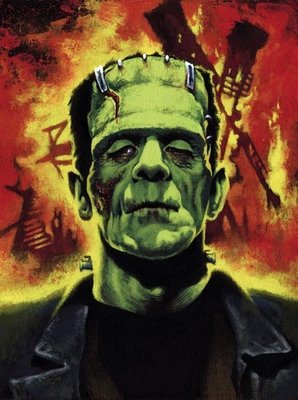
Frankenstein: The True Story is a 1973 American made-for-television horror film loosely based on the book Frankenstein by Mary Shelley. It was directed by Jack Smight, and the screenplay was co-written by novelist Christopher Isherwood.
The film starred Leonard Whiting as Victor Frankenstein, Jane Seymour as Prima, David McCallum as Henry Clerval, James Mason as Dr Polidori and Michael Sarrazin as the Creature. James Mason's wife, Clarissa Kaye-Mason also appeared in the film.
The character of Dr Polidori, who did not appear in the original novel, was based on the real-life John Polidori, an acquaintance of author Mary Shelley who was part of the competition that produced her novel. Polidori's own contribution was the first modern vampire story The Vampyre (1819).
A notable feature of the production is that, instead of being ugly from the start, the Creature is portrayed as physically beautiful but increasingly hideous as the film progresses. The make-up was by Hammer horror veteran artist Roy Ashton.
It was originally broadcast in two 90-minute parts, but is often seen edited into a single film. Its DVD debut date was September 26, 2006. Included at the beginning is a short intro featuring James Mason wandering through St John's Wood churchyard, London. He suggests that this is where Mary Shelley is buried, which is incorrect (she is in actual fact buried in the family plot in Dorset), despite standing beside a gravestone bearing her name.
Plot
PART ONE Victor Frankenstein is an affluent young man training as a doctor, engaged to Elizabeth Fanshawe, daughter of a highly respected Lord and Lady. After Victor's younger brother, William, drowns in a tragic boat accident, Victor renounces his belief in God and declares that he would join forces with the Devil if he could learn how to restore his brother to life.
Shortly afterward, Victor leaves for London to train in anatomy. He immediately meets a socially odd but ambitious scientist named Henry Clerval, who Victor later learns has discovered how to preserve dead matter and restore it to life. As Victor becomes fascinated by Clerval's experiments (which at this point involve only insects and an amputated but still living human forearm), Clerval reveals his ultimate plan: creating a new race of invincible, physically perfect beings by using solar energy to animate "the Second Adam" constructed from parts of corpses. For some years Clerval has rented an isolated chateau where he's been building the huge laboratory apparatus to accomplish this feat. However, he is unable to complete it on his own due to a worsening heart condition. When Frankenstein eagerly volunteers himself as Clerval's associate, the work begins in earnest and the lab is completed. All they need now is to obtain the right body, before winter comes to block out the sun until Spring.
As luck would have it, word reaches the pair that several peasant lads have been killed in a mine collapse. After their burial the doctors quickly dig up the bodies and, choosing the best parts from each, stitch together a physically perfect human. The night before the creation event, however, Clerval discovers that the reanimated arm - ignored for weeks during the construction of the lab and of "Adam" - has become diseased, unsightly and deformed. The shock of this reversal kills Clerval just as he is recording the discovery in the journal.
The next morning, Victor finds Clerval's body and misreads the incomplete journal entry ("The process is r---") as saying "the process is ready to begin" rather than "reversing itself," which Clerval intended to write. Since neither of them wanted the perfect body to have the brain of a mere peasant, Victor transplants Clerval's brain into their creation. He is able to complete the experiment, and the result is a strikingly handsome, youthful and articulate creation, immensely strong and capable of quick learning. In awe of the creation, Victor educates him and introduces him into high-class London society, passing him off as a relative from a far-off country who speaks little English.
Victor's creation has won the admiration of London's elite class, but Victor soon discovers the still-living but now repulsive arm in Clerval's cupboard. He realizes some flaw in the process dooms it to reverse itself and destroys the deformed arm with acid, but is soon horrified to discover the beginnings of the Creature's deformity.
The adulation he has received has caused the Creature to grow very vain, so Victor destroys all mirrors in his rooms and laboratory while desperately searching for a way to correct the problem. He is unsuccessful, and the Creature's degeneration into a coarse, monstrous thing accelerates. This fact begins to change Victor's feelings towards his own creation and he finds himself beginning to reject the helpless Creature while the Creature is unable to understand Victor's change in attitude towards him.
When Victor's landlady, Mrs. Blair, enters Victor's room and sees the still friendly but grossly degenerated Creature, she dies of shock. Victor is forced to take the Creature back to the laboratory for safety. So at a loss for a remedy is he that Victor even contemplates destroying the sleeping creature with acid (as he did with the monstrous arm) but cannot bring himself to do it.
Detecting Victor's changing attitude towards him, the Creature notices the changing bone structures of his own hands and face. He searches for any reflective surface, and finally viewing its now horrible visage he screams and wakes Victor. The Creature weeps and pleads for help but Victor, exhausted and defeated, simply stares at him coldly. The rejection causes the Creature's mind to snap. Flinging Victor aside, he repeatedly stabs himself in the heart with a shard of broken glass. But the stabbing does no harm, so in frustrated rage the Creature flees the laboratory. He runs straight for the nearby White Cliffs of Dover, where he intends suicide by throwing himself into the sea below. Victor chases him to the cliff's edge and briefly gets the Creature to stop. However, realizing that it actually would be better for them both if he dies, Victor again finds he has nothing to say. The saddened Creature nods slowly and leaps from the cliff, landing with crushing impact in the sea far below.
The next scene shows the Creature's still form washed up on a beach. Slowly he stirs and rises; finding himself alive and unharmed, he slowly wanders away. This scene marks the end of the first half of the film.
PART TWO At the beginning of the second part we see the Creature wandering through the woods, where he befriends an elderly blind peasant. Presumably, some weeks pass; the blind man is eager to introduce his new friend to his grandchildren Felix and Agatha, the latter of whom the Creature falls in love with. The Creature hides from them every time they return home, afraid of letting anyone see his face, which the blind man attributes to pure shyness. Felix and Agatha choose to surprise their grandfather's friend by turning up unexpectedly, but upon seeing the Creature, Agatha flees into the woods in terror while Felix attacks. In self-defense, the Creature reflexively flings Felix away from him, his incredible strength smashing Felix's skull open against the wall. He then pursues Agatha into the woods, but as she runs from him in fright she stumbles into the passage of a horse-drawn carriage. Agatha is run over and instantly killed.
Grief-stricken, the Creature takes the body and carries it back to Frankenstein's laboratory, intent on asking his creator to restore her to life. He arrives to find that Victor has long since left and that the laboratory is now occupied by Dr. Polidori, the crippled former mentor of Clerval (Polidori's useless hands are later revealed to be horribly twisted and burned). Polidori has his own, unique approach to the creation of life. Having become aware of Victor's failed experiment and discovering through mesmerism that Henry Clerval's brain resides in the Creature's body (in a hypnotic state, Clerval's personality surfaces), Polidori agrees to help the Creature's beloved Agatha, but secretly he has other plans for the both of them.
Victor, having abandoned his experiments after the Creature's apparent suicide, has now returned to his country house to marry Elizabeth. But on the day of his wedding he is visited by Polidori, who uses the now-docile Creature to blackmail Victor into helping him create a female being. In exchange, Polidori promises that Victor will be forever free of them all once the experiment is complete. Victor reluctantly agrees, and much to Elizabeth's dismay leaves her alone on their wedding night to join Polidori in his laboratory.
That night, Polidori reveals that it was he who perfected the preservation and reanimation of dead flesh by use of obscure chemical compounds. He scoffs at the use of solar power and blames "the shocks" incurred during the procedure as the reason for the Creature's degeneration. During their prior association, Clerval apparently stole Polidori's preservation secrets and left the helpless Polidori without assistance. Desiring fame and racing against his own increasing weakness, however, Clerval came to believe the solar route would be a quicker and simpler way to accomplish the same goal. As a result, Clerval had dismissed Polidori's alchemical approach as being out of the Middle Ages and not worthy of serious attention.
Now Polidori intends to create a perfect female being using his own methods, and assures Victor it can be done. Keeping Victor's own increasingly temperamental creature locked away like an animal, the crippled Polidori employs Victor's hands in attaching Agatha's head to its new body. Together, they bring to life a beautiful female creature whom Polidori names Prima. The deal is done, Victor believes himself forever free of both his creature and Polidori and leaves for a several months-long honeymoon with Elizabeth.
In their absence and despite his earlier vow, Polidori insinuates his "ward" Prima and himself into the Fanshawe household for the purpose of Prima being educated and introduced into society. Enraged at seeing Polidori upon his return, Frankenstein reluctantly complies with his wishes and decides not to interfere with Polidori's plan. It becomes quickly obvious that Prima is soulless and evil, and Elizabeth becomes suspicious of her after she deliberately tries to strangle a kitten. Suspicious about the black neckband which Prima insists on wearing permanently around her neck, Elizabeth removes it as Prima sleeps, revealing the stitches by which her head has been sewn on. In horror, she begs Victor to dismiss her from the house.
At the laboratory Victor confronts Polidori, who smilingly tells him that he and Prima will be moving on shortly. However, there is one loose end to tie up: Victor's creation, which has been confined in the cellar. As a show of good faith that he now really means to set Victor free, Polidori hypnotizes the Creature and puts him to sleep at the edge of a vat of acid. The servants are about to push him to his destruction but, at the last moment, Victor cries out for the creature to wake up. He does so, hurling one of the servants into the acid as Polidori locks him in the basement. Polidori has his remaining servant set fire to the building with the Creature trapped inside and rightly chastises Victor for his hypocrisy, telling him that he loved his creature "so long as it was pretty, but when it lost its looks that was a different matter!" The volatile chemicals still stored in the building explode magnificently, leveling the chateau and presumably burning the Creature to death and burying his remains deep beneath the rubble.
Later on, a ball to present Prima to society is held at the Fanshawe mansion. Prima - an incredible mimic and who has seen a ballet only once - performs an amazing ballet dance routine which stuns all the guests. Beaming with pride, Polidori finally explains to a drunken Victor his true plan: Prima is his key to enter and gain control of the highest levels of society, and with it, international political power.
At that moment, Frankenstein's badly burned Creature bursts into the ballroom. Scattering the guests, he makes his way towards Prima. Killing attacking servants bare-handed and ignoring shotgun blasts fired point-blank into his torso, he rips away the now savage Prima's neckband, revealing her neck scar to the horrified crowd. Then, in revenge for what was done to his beloved Agatha, he slowly rips off Prima's head and drops it at Polidori's feet. As Polidori breaks down in tears over Prima's death, the Creature kneels beside Victor. Due to his limited vocabulary he cannot explain why he destroyed Prima beyond the single word "beautiful".
The next day a police investigation begins and Victor tries to tell the whole, unbelievable truth. Elizabeth intervenes, convincing the inspector in charge that Victor has been suffering from mental strain and that Polidori is responsible for everything. Elizabeth and Victor choose to leave England and voyage to America to begin life anew.
Victor and Elizabeth board the ship but soon find that Polidori is also on board. He insists that, now that they've all lost everything, Victor and he will continue their experiments in America and will not accept their refusal. Elizabeth goes to Polidori's cabin to confront him. As she does she glimpses the stowaway Creature hiding there. She locks Polidori in the cabin with the Creature and takes the key. When she tells Victor what she has done, his sense of morality urges him to set Polidori free. He does, but the now-vengeful Creature pursues Polidori onto the deck. The Creature ties a rope around Polidori and hoists him high into the lightning storm above. In an attempt to stop Polidori's murder, Victor is struck by a swinging plank and falls to the deck unconscious.
Polidori is struck by lightning and killed (the Creature is struck first, but he just laughs it off). The ship's crew see this and believe it to be the Devil himself; they abandon ship and flee in a lifeboat, leaving only Victor, Elizabeth and the Creature on board. Elizabeth cruelly taunts the Creature with the knowledge of her pregnancy (Victor's "true" creation of life out of life, rather than the Creature's aberrant, repulsive life from death). Enraged, the mind of Clerval surfaces, and the Creature strangles her to death. The Clerval part of the Creature carefully observes and treats Victor's condition, after having lashed the wheel of the ship on a due north heading, straight for the uncharted wilderness of the North Pole.
When Victor finally awakens, he finds the frozen body of Elizabeth on deck and the ship itself locked in ice. Victor sees the Creature's footprints leading away from the ship, making their way across the ice plain to what appears to be a cavern at the base of a large ice-locked berg. Here he confronts his creature one final time, asking if the Creature has punished him enough for giving him life. But Victor is overcome by remorse, realizing that this whole tragedy was caused by his rejection of the helpless, deteriorating creature, who - upon Victor's soon and certain death - will be utterly alone, cursed with an "iron body" that, even here, will keep him alive against his will. Victor begs the Creature's forgiveness; the sound of his shouts sets off an ice avalanche. As tons of ice begins to fall upon them both, the Creature (in Clerval's voice) forgives his creator, and they embrace as they are buried by the avalanche. The film ends.


 Early national attention to trick-or-treating was given in October 1947 issues of the children's magazines Jack and Jill and Children's Activities, and by Halloween episodes of the network radio programs The Baby Snooks Show in 1946 and The Jack Benny Show and The Adventures of Ozzie and Harriet in 1948. The custom had become firmly established in popular culture by 1952, when Walt Disney portrayed it in the cartoon Trick or Treat, Ozzie and Harriet were besieged by trick-or-treaters on an episode of their television show, and UNICEF first conducted a national campaign for children to raise funds for the charity while trick-or-treating.
 A jack-o'-lantern (sometimes also spelled Jack O'Lantern) is typically a carved pumpkin. It is associated chiefly with the holiday Halloween. Typically the top is cut off, and the inside flesh then scooped out; an image, usually a monstrous face, is carved onto the outside surface, and the lid replaced. During the night, a candle is placed inside to illuminate the effect. The term is not particularly common outside North America, although the practice of carving lanterns for Halloween is.
  Despite the colorful legends, the term jack-o'-lantern originally meant a night watchman, or man with a lantern, with the earliest known use in the mid-17th century; and later, meaning an ignis fatuus or will-o'-the-wisp. In Labrador and Newfoundland, both names "Jacky Lantern" and "Jack the Lantern" refer to the will-o'-the-wisp concept rather than the pumpkin carving aspect.

 Beliefs in witchcraft, and resulting witch-hunts, are both found in many cultures worldwide, today mostly in Sub-Saharan Africa (e.g., in the witch smellers in Bantu culture), and historically notably in Early Modern Europe of the 14th to 18th century, where witchcraft came to be seen as a vast diabolical conspiracy against Christianity, and accusations of witchcraft led to large-scale witch-hunts

 Tiffany has proven her love for Chucky for years. She wore what she thought was an engagement ring from him ever since he was killed, and she even has a tattoo of a heart with a knife through it and Chucky's name written above it. While Chucky laughed at the idea of him marrying Tiffany, there is no doubt he has some sort of feelings for her. When the two of them were alone in the van while Jesse and Jade were getting married, Chucky apologizes to Tiffany "for everything". After Tiffany kills the two newlyweds by throwing a champagne bottle into the ceiling mirror, Chucky is impressed. This was actually what made Chucky finally say "I love you Tif!" and proposes to her. Chucky is down on one knee and holding the severed finger with the wedding ring still attached, and says he should have asked her to marry him a long time ago. Also in the Hackensack Cemetery when Jesse threatens to shoot Tiffany in the head when Chucky has Jade hostage, Jesse tells Chucky to let Jade go and he'll let Tiffany go, Chucky has no choice but to agree. When they are resurrected in Seed of Chucky, Chucky and Tiffany kill one of the Hollywood workers together with a piece of wire. Moments later, they are seen passionately kissing. When Tiffany wants her and Chucky to stop murdering people, it seems that she has no control over herself, while Chucky seems indifferent to murder. Tiffany seems deeply upset when she kills Jennifer Tilly's friend, Joan. Chucky does all he can to comfort her before realizing it was Glenda. Just as Chucky is performing the ritual to transfer his, Tiffany's and Glen's souls into their victims' bodies, there is a moment of shouting and frustration which angers Chucky. He firmly decides that he wants to remain a doll and that being human isn't so great. Chucky states that he already has everything he wants, "a beautiful wife" and a "multi-talented kid." Tiffany leaves him, taking Glen, causing Chucky to become heartbroken and enraged. He hits tiffany in the head with an ax not realizing that just before she had already transferred her soul in jennifer tilly's.


 The legends of ulfhednar mentioned in Vatnsdœla saga, Haraldskvæði and the Völsunga saga may be a source of the werewolf legends. The ulfhednar were vicious fighters similar to the better known berserkers, who were dressed in bear hides and reputed to channel the spirits of these animals to enhance effectiveness in battle; these warriors were resistant to pain and killed viciously in battle, much like wild animals. Ulfhednar and berserkers are closely associated with the Norse god Odin.


 Shortly afterward, Victor leaves for London to train in anatomy. He immediately meets a socially odd but ambitious scientist named Henry Clerval, who Victor later learns has discovered how to preserve dead matter and restore it to life. As Victor becomes fascinated by Clerval's experiments (which at this point involve only insects and an amputated but still living human forearm), Clerval reveals his ultimate plan: creating a new race of invincible, physically perfect beings by using solar energy to animate "the Second Adam" constructed from parts of corpses. For some years Clerval has rented an isolated chateau where he's been building the huge laboratory apparatus to accomplish this feat. However, he is unable to complete it on his own due to a worsening heart condition. When Frankenstein eagerly volunteers himself as Clerval's associate, the work begins in earnest and the lab is completed. All they need now is to obtain the right body, before winter comes to block out the sun until Spring.